SNAP 2026 Mock Test Series: 92 Tests Built for the New 4-Section Exam
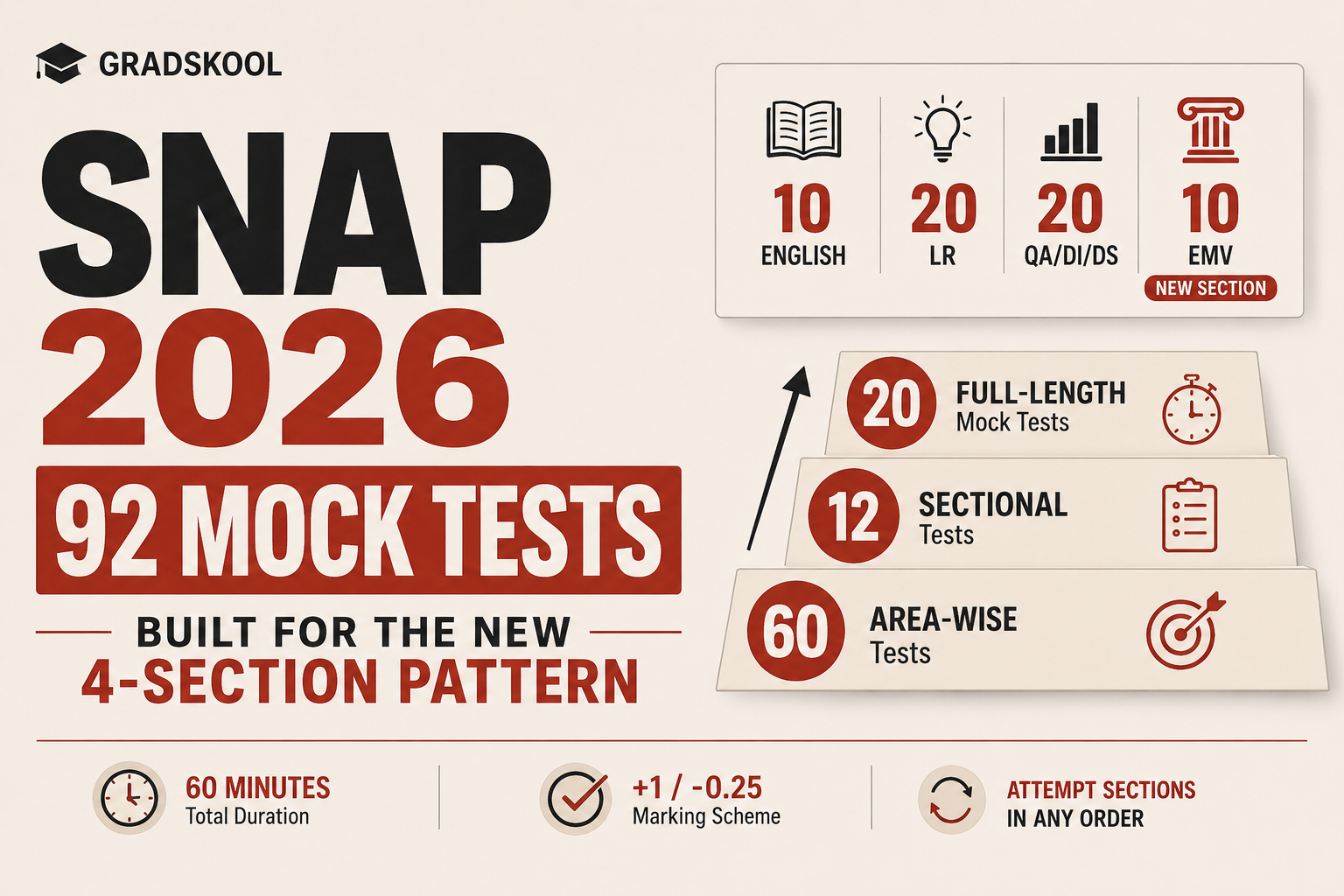
SNAP 2026 isn't the same exam you prepared for last year.
The biggest change is obvious. Ethics, Morality & Values (EMV) is now a dedicated section of the test.
That changes more than just the syllabus. It changes the way you need to practise.
A mock test built around the old three-section SNAP pattern cannot properly simulate an exam that now has four sections, 60 questions, a dedicated EMV component, and a 60-minute overall time limit.
That's why we built the GRADSKOOL SNAP 2026 Mock Test Series around the new structure from the ground up.
Not 20 full mocks repeated over and over. Not a collection of random topic tests. A 92-test preparation ladder designed to take you from focused practice to full exam simulation.
92 Tests. Three Levels of Practice.
The series follows a simple progression.
Area-Wise → Sectional → Full-Length
You first build individual skills. Then you test them within a section. Then you put everything together under full exam pressure.
20 Full-Length Mock Tests
These are complete simulations of SNAP 2026.
Each full-length test follows the four-section structure published by the official SNAP Test website:
Section | Questions |
|---|---|
General English | 10 |
Analytical & Logical Reasoning | 20 |
Quantitative, Data Interpretation & Data Sufficiency | 20 |
Ethics, Morality & Values | 10 |
Total | 60 |
The official SNAP 2026 structure gives candidates 60 minutes for 60 questions, with +1 for a correct answer and a 25% penalty for an incorrect answer. There is no sectional time lock, so candidates can decide how to distribute their time across the four sections.
That's important. A SNAP mock isn't just testing whether you can solve questions. It's testing whether you can make the right decisions with a clock running.
Which section do you start with?
How long do you spend on a difficult question?
When do you move on?
How much time do you reserve for EMV?
When do you return to unanswered questions?
The full-length tests are where you practise those decisions before the actual exam makes them for you.
12 Sectional Tests
The next layer is focused sectional practice.
You get three sectional tests for each of the four sections:
- General English
- Analytical & Logical Reasoning
- Quantitative, Data Interpretation & Data Sufficiency
- Ethics, Morality & Values
That's 12 sectional tests in total.
These are particularly useful when your overall score isn't the problem, one particular section is. Instead of taking another full mock and discovering the same weakness after 60 minutes, you can isolate the section, practise it under pressure, analyse the result, and work on the specific problem.
60 Area-Wise Tests
This is where the series goes deeper.
You get 60 focused area-wise tests covering individual topics within the four sections.
Why? Because there's a missing step in the way many students prepare.
Concept → Full Mock
That's too big a jump. You might understand a topic but still be slow. You might be fast but inaccurate. You might know the concept but struggle when the question is presented differently.
Area-wise tests provide the intermediate layer where you can identify and fix those problems.
The 92-Test Preparation Ladder
Put simply:
60 Area-Wise Tests — Build the skill.
12 Sectional Tests — Test the skill under section-specific pressure.
20 Full-Length Tests — Simulate the complete examination.
That's the philosophy behind the series.
Don't just take more mocks. Progress through them.
Built on the Official SNAP 2026 Pattern
We built the full-length mocks around the structure published by the official SNAP Test website.
SNAP 2026 has four sections.
General English, 10 questions.
Analytical & Logical Reasoning, 20 questions.
Quantitative, Data Interpretation & Data Sufficiency, 20 questions.
Ethics, Morality & Values, 10 questions.
That's 60 questions in 60 minutes.
The official marking scheme is +1 for a correct answer and −0.25 for an incorrect answer, and candidates can attempt the sections in any order. That means strategy is part of the examination, and it means realistic full-length mocks matter.
A good SNAP mock shouldn't simply ask, "How many questions can you solve?"
It should also force you to answer, "How should I spend my 60 minutes?"
That's what the full-length tests are designed to do.
And Then There's EMV
This is the part we want to be particularly transparent about.
Ethics, Morality & Values is new to SNAP 2026.
There are no previous SNAP EMV papers to use as a historical question bank. There is no five-year pattern to reverse-engineer. And no mock provider, including GRADSKOOL, can honestly claim that its EMV questions are "real SNAP questions" before the actual examination happens.
We don't want to pretend otherwise.
So how did we build our EMV questions?
We built them around the ALP Framework and the kinds of structured ethical reasoning that the new section is designed to assess.
The framework works through:
Stakeholders → Conflict → Principle → Consequences → Elimination → Answer
The objective isn't to predict the exact scenario SNAP will ask. That's impossible. The objective is to practise the underlying skill, taking an unfamiliar ethical situation and arriving at a defensible decision under time pressure.
That's a much more useful thing to practise. Whatever scenario appears on the actual paper, you won't have seen that exact scenario before.
What EMV Practice Should Actually Do
A useful EMV mock shouldn't reward you simply for remembering that honesty is good, fairness is important, and responsibility matters. Those statements are easy.
The difficult part is deciding what happens when two good principles conflict.
Should you protect a colleague or disclose their mistake?
Should you prioritise an individual or the larger group?
Should you follow a rule even when the outcome is worse?
Should you disclose information immediately or consider the consequences of doing so?
These are the situations where structured reasoning matters. That's why EMV practice in our mocks focuses on application rather than memorisation.
The Difference Between Taking a Mock and Analysing One
There is another reason we built 92 tests.
Taking a mock is not preparation by itself. Analysis is preparation.
A student can take 20 mocks and make the same mistakes 20 times. Another student can take fewer mocks but systematically identify questions they should have attempted, questions they should have skipped, recurring conceptual errors, calculation mistakes, time-management problems, sections where accuracy collapses under pressure, and questions where the correct answer was missed because of poor decision-making.
The second student is actually using the mock series.
That's the approach we recommend.
Take → Analyse → Fix → Retake
The purpose of the next mock isn't to prove that you're good. It's to reveal what still needs fixing.
Who Is the 92-Test Series For?
Starting your SNAP preparation? Use the area-wise tests to build familiarity before moving into full-length simulations.
Already preparing but struggling with specific areas? Use sectional and area-wise tests to isolate the problem rather than repeatedly taking full mocks.
Preparing for SNAP and XAT together? The formats are different, but several underlying skills overlap across reasoning and quantitative preparation. The new EMV section also gives SNAP aspirants an additional area that requires dedicated practice.
Looking for realistic full-length practice? The 20 full-length mocks are designed around the current four-section structure and 60-minute examination environment.
Try the First Mock Free
We don't expect you to buy 92 tests because a blog post told you they're good.
Take the first mock.
Your first mock is free. No card required. No commitment.
Take it under proper 60-minute conditions and see where you actually stand. Then analyse it.
If you find the series useful, the complete 92-test SNAP 2026 mock series is ₹1,499.
If you're also preparing for NMAT, you can get the SNAP + NMAT mock bundle for ₹2,499 instead of ₹2,998 separately.
Get Started
Explore SNAP 2026 on GRADSKOOL →
Want the mock series, free or full?
92 Tests. One Objective.
The point of a mock series isn't to give you a large number printed on a sales page.
It's to help you answer one question with increasing confidence. If SNAP 2026 happened today, how ready am I?
The 92-test series is built to help you answer that question repeatedly, and improve the answer each time.
60 Area-Wise Tests. 12 Sectional Tests. 20 Full-Length Mocks.
92 tests. The new pattern. The real pressure.
Don't guess where you stand. Take the test.
Want to understand the complete SNAP 2026 structure first?
Read: SNAP 2026 Exam Pattern →
Want to understand the new EMV section?
Read: SNAP 2026 Ethics, Morality & Values: New EMV Section Decoded →