The Only Dedicated SNAP Ethics, Morality & Values Prep Course We Could Find
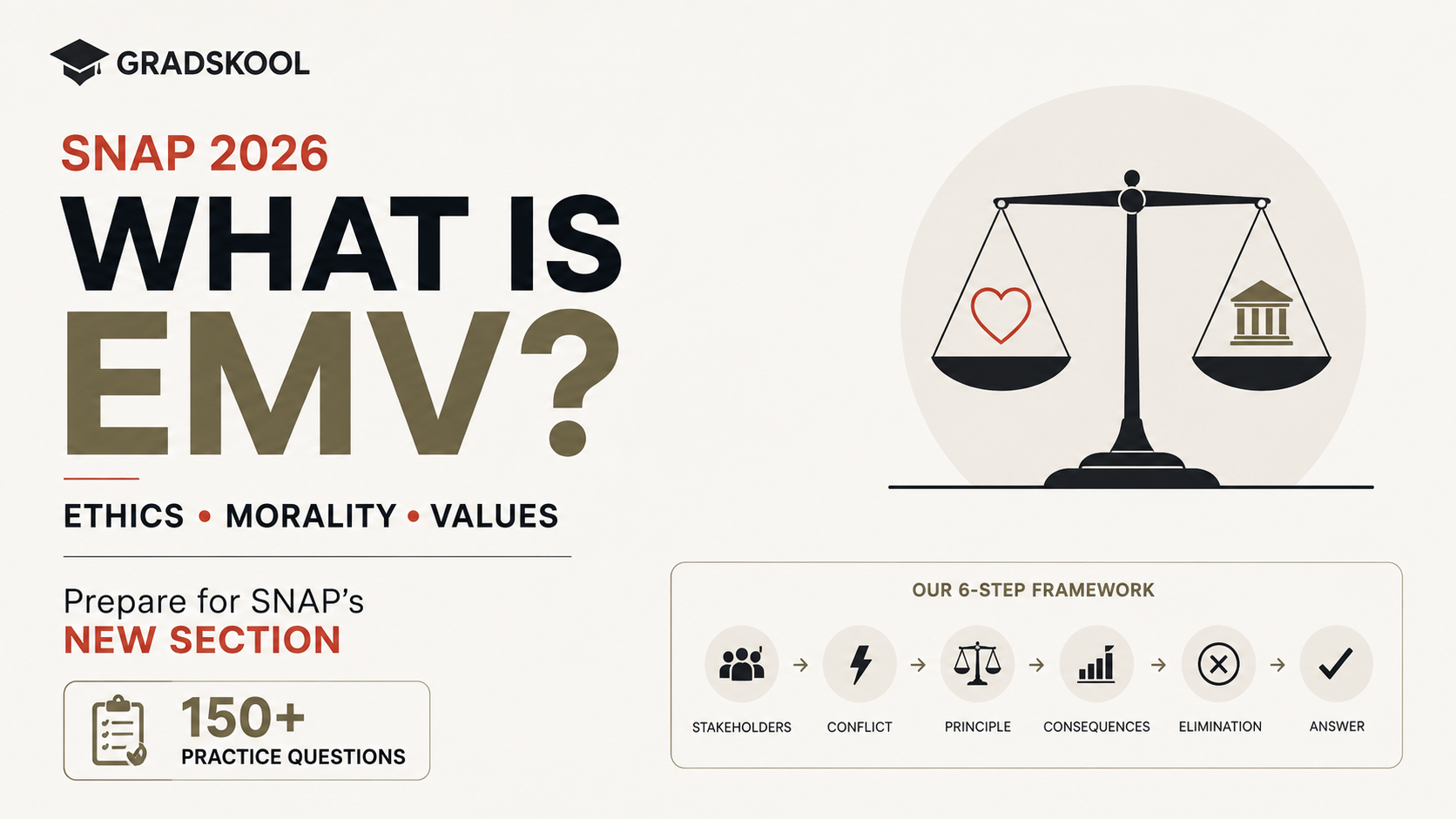
We looked. We searched major MBA coaching platforms, SNAP preparation websites, and the broader internet for dedicated preparation for SNAP 2026's new Ethics, Morality & Values section.
As far as we could find, GRADSKOOL is the only platform currently offering a dedicated, structured course built specifically around SNAP's new EMV section.
Not a chapter buried inside a larger course. Not a blog post pretending to be preparation material. An actual course, with its own curriculum, practice bank, and problem-solving framework.
Here's what's inside.
Why This Course Exists
SNAP 2026 has introduced a section that students have never prepared for before.
There are no previous SNAP EMV papers to analyse. No decade of recurring question types. No established collection of shortcuts. No universally accepted preparation strategy.
Everyone is starting from roughly the same blank page.
We didn't think that was a reason to wait for someone else to figure it out.
So we built the preparation ourselves.
More importantly, we built it around a simple idea.
When you don't know what the next question will look like, memorising more information isn't enough. You need a framework for thinking.
That's what this course is designed to provide.
What's Actually Inside
The course is structured around six components, taking you from zero familiarity with EMV to exam-ready application.
1. Ethics, Morality & Values: Core Concepts
Before you can reason through an ethical dilemma, you need to understand what you're actually dealing with.
What is ethics? What is morality? What are values? How do they overlap, and where do they differ?
This module builds the conceptual foundation without turning the course into a philosophy lecture.
The goal is simple. Understand the language of the section before you start solving it.
2. Core Ethical Principles
Ethical dilemmas often involve competing ways of judging an action.
Should we focus on the consequences?
Should we focus on the principle behind the action?
Should we consider the character and intentions of the person involved?
You don't need to memorise a list of philosophers to answer SNAP questions.
You need to recognise the underlying reasoning patterns when they appear in an unfamiliar situation.
That's what this module teaches.
3. Ethical Frameworks
This is the heart of the course.
We've developed a practical six-step framework for approaching unfamiliar ethical dilemmas.
Stakeholders. Conflict. Principle. Consequences. Elimination. Answer.
The objective is not to tell you what the answer to a particular dilemma is.
The objective is to give you a process you can use when the dilemma is completely new.
And that's especially important for SNAP EMV.
Because on exam day, every dilemma will be one you've never seen before.
4. Business & Workplace Ethics
SNAP is a management entrance examination.
So ethical questions are unlikely to exist entirely in a philosophical vacuum.
This module focuses on situations involving:
- Conflict of interest
- Whistleblowing
- Confidentiality
- Data privacy
- Corporate responsibility
- Professional conduct
- Accountability
- Workplace relationships
The emphasis is not merely on knowing definitions.
It's on recognising the ethical issue when it appears inside a realistic professional scenario.
5. Ethical Dilemmas
This is where the theory meets the messiness of real decisions.
You will encounter situations where there isn't an obviously perfect answer.
Two options may both appear reasonable.
One may protect a colleague while another protects an organisation.
One may produce a better immediate outcome while another follows a stronger principle.
The skill being tested is therefore not simply identifying what feels right.
It's identifying the most defensible course of action given the stakeholders, principles, conflicts, and consequences involved.
6. Ethical Decision-Making
The final component brings everything together.
You learn how to move from Situation to Analysis to Evaluation to Decision.
The objective is to make the framework increasingly automatic, so that you can apply it under SNAP-style time pressure rather than spending several minutes debating every option.
A Quick Look at the Framework in Action
Let's take a simple example.
The Situation
A team member privately tells you that they made an error in a client report that has already been sent.
Fixing the error means informing the client and potentially risking the account.
Keeping quiet means the mistake may never be discovered, but the client is currently making decisions based on incorrect information.
What should you do?
Instead of relying on instinct, run the framework.
Stakeholders
The client.
The team member.
The organisation.
The team's professional credibility.
And the long-term relationship built on trust.
Conflict
You are balancing loyalty towards a colleague against honesty and the client's right to accurate information.
Principle
Transparency and accountability generally carry greater weight than protecting yourself or a colleague from short-term embarrassment, particularly when the error affects a client's decision-making.
Consequences
Disclosing the error may cause discomfort and could potentially damage the relationship.
But it gives the organisation an opportunity to correct the problem.
Keeping quiet may avoid immediate consequences, but creates a much greater risk if the client discovers the error independently.
Elimination
Any option that involves permanently hiding the error becomes difficult to defend.
So does publicly blaming the team member instead of taking collective responsibility for correcting the problem.
Answer
Disclose the error promptly, take responsibility as a team, and correct the report.
That's the framework in action.
And this is exactly the kind of thinking the course is designed to develop.
150+ Practice Questions
The course doesn't stop at theory.
It includes 150+ practice questions, built around ethical scenarios and decision-making situations, with detailed explanations for each.
The purpose isn't simply to give you 150 answers.
It's to give you 150 opportunities to practise the process.
Because with a brand-new section, there is a limit to how much you can learn from memorising content.
You have to learn how to think through the question in front of you.
What You Get
- Complete recorded course covering all six components
- 150+ practice questions
- Detailed explanations
- A repeatable six-step ethical decision-making framework
- Business and workplace ethics scenarios
- Ethical dilemma practice
- Exam-oriented application rather than purely theoretical discussion
- Designed specifically for SNAP 2026 EMV preparation
Designed by ALP Sir, 99.93 percentile CAT, 770 GMAT.
Frequently Asked Questions
Is this course only for SNAP, or does it help with other exams too? It's built specifically for SNAP's EMV section, but the framework itself, judging dilemmas through stakeholders, conflict, principle, and consequences, transfers directly to XAT's Decision Making section, which tests similar reasoning.
Do I need a philosophy or ethics background to take this course? No. The course starts from the basics of what ethics, morality, and values actually mean, and builds up from there. No prior background assumed.
How is this different from just reading about ethics online? Reading builds awareness. This course builds a process. The framework is designed to be applied under exam time pressure to dilemmas you've never seen, which reading alone doesn't train you to do.
Will the practice questions match what SNAP actually asks? Nobody can guarantee that, since SIU hasn't released an official EMV syllabus and this is the section's first year. What the course guarantees is a tested reasoning process that applies regardless of the exact scenario SNAP presents.
Why We're Telling You This Now
Being early is useful only when you actually use the head start.
SNAP EMV is still a new territory. There is no established decade-long preparation playbook for it. Dedicated preparation is still relatively rare.
That gives students preparing seriously for SNAP 2026 an unusual opportunity.
You don't have to wait for the section to become predictable. You can prepare for the uncertainty itself.
That's the philosophy behind this course.
We don't know exactly what SNAP will ask.
Neither does anyone else.
What we can do is teach you how to approach the questions when they arrive.
Explore the SNAP 2026 EMV Course →
Want to understand the new section before enrolling?
Read our companion guide: SNAP 2026 Ethics, Morality & Values: New EMV Section Decoded